
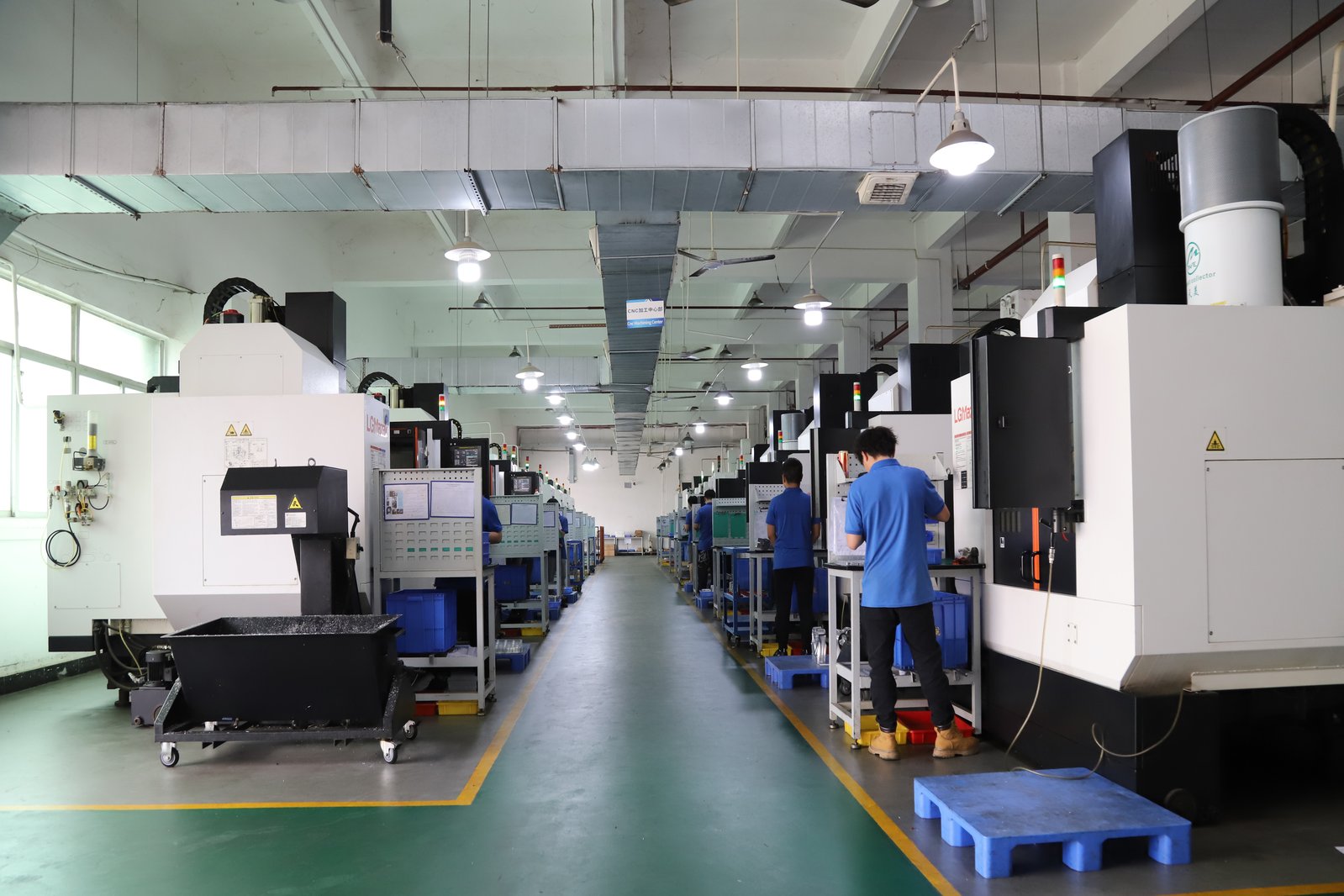
Aluminum or stainless steel is the most common material question a CNC machining buyer faces, and the answer is decided by more than corrosion. The two families differ in stiffness, weight, thermal behavior, machinability, and finishing routes, and on a machined part those differences land directly in the quote, the lead time, and the service life. This guide compares 6061-T6, 7075-T6, 303, 304, 316L, and 17-4PH on the axes that matter for CNC machined parts, with a decision table you can bring to the next design review.
Why does the material call matter more on a machined part?
On a machined part there is no production history to absorb a material mistake — the drawing, the material, and the process are decided together the first time. A wrong alloy callout costs a full cycle: the quote, the machining strategy, the finish, and the schedule all change when the material changes, and on a first run there is no batch to spread the rework across. The grade belongs on the drawing before the RFQ goes out.
The two families differ in ways that matter immediately. Stainless is roughly three times stiffer than aluminum, so a thin-wall part that flexes under cutting load in aluminum may cut cleanly in stainless. Stainless also work-hardens if the tool dwells, so the machining strategy must keep the tool engaged, while aluminum machines at speed with light forces. Both hold the same production capability — ±0.003 mm on milled and turned features, ±0.002 mm by precision grinding, with Ppk ≥ 1.67 at the initial study on key characteristics and Cpk ≥ 1.33 on general characteristics. Capability is reported per characteristic: every report names the feature, its tolerance band, the sample size, the sigma method, and the study window., but the path and the price are different.
The DFM review should read the material as carefully as the geometry. A shop that asks whether a thin wall is load-bearing before it chooses between aluminum and stainless, or which features need a grinding step, is planning the part; one that quotes both materials at the same price has not thought about either. A machined part has no history to absorb a mismatch, so the drawing, the material, and the process are decided together the first time.
What do 6061-T6 and 7075-T6 give you in aluminum?
6061-T6 is the workhorse. Its yield strength of about 276 MPa is modest, but it machines cleanly at high speed, holds tolerance without drama, finishes well, and takes anodize reliably, which makes it the default for housings, brackets, and prototypes across industries. Its density of 2.70 g/cm³ is about a third of steel, and its thermal conductivity is roughly ten times that of stainless, which is why heat-management parts are almost always 6061. The aluminum capability of a full machining line is covered in the aluminum machining guide.
7075-T6 is the upgrade when the design is strength-limited. Its yield strength of about 500 MPa approaches some steels at a third of the weight. The costs of that strength: roughly two to three times the stock price of 6061, slightly slower machining, and lower corrosion resistance in some conditions, so 7075 parts are usually anodized or painted in service. Confirm the temper is available in the stock size you need before finalizing the drawing — a grade that is hard to source as certified bar costs you twice, in price and in schedule.
Availability shapes the quote as well. Aluminum tempers in common rounds and plates are stocked everywhere; some stainless grades and heat-treated tempers are available only to order, which adds both cost and days. Let the drawing reference the standard tempers the market actually carries and ask the shop which grade it stocks — a stock size you can use today beats a marginally cheaper grade that must be bought in.
Which stainless grades matter for machined parts?
Stainless is a family, not a material, and the grades differ in both the part and the quote. All sit near 7.9 g/cm³ — about three times denser than aluminum — with a Young's modulus near 193 GPa, giving roughly three times the stiffness of aluminum for the same geometry.
| Grade | What it is | Machining behavior | Typical machined parts |
|---|---|---|---|
| 303 | Free-machining austenitic; added sulfur breaks chips | Best machinability of the family; clean finish | Fittings, valve stems, sensor housings, fasteners |
| 304 | General-purpose austenitic | Moderate; work-hardens if cuts are light or tools dwell | Structural and food-contact parts, enclosures |
| 316L | Adds molybdenum for chloride and pitting resistance; low carbon | Moderate; tougher on tooling than 304 | Marine, chemical, and pharmaceutical components |
| 17-4PH | Precipitation-hardening martensitic | Machines well annealed; strong after heat treatment | High-strength structural parts, actuators |
The rule of thumb: 303 when you need a corrosion-resistant machined part at the lowest machined cost, 304 when the part is also welded or formed, 316L when chlorides and process chemicals are in the picture, and 17-4PH when you need real strength rather than corrosion resistance alone. The machining behaviors behind each grade are expanded in the stainless steel machining guide.
When is 17-4PH the right stainless over 304 or 316L?
If the part is a housing that keeps water out, 304 or 316L is fine. If the part carries load — a clevis, a link, a bracket in a mechanism that sees vibration — the annealed austenitics cap out near 200–300 MPa yield, and a strong stainless part becomes a big, heavy part. 17-4PH solves that: in the H900 condition it reaches yield strengths around 1100 MPa, stronger than most carbon steels, while keeping the corrosion resistance of the family.
That strength changes the design conversation. A load-bearing stainless part in 17-4PH can be smaller and lighter than the equivalent 304 design, which is why actuators, valve components, and precision mechanisms specify it. The trade-offs are scheduling: 17-4PH is machined soft, heat-treated, and then finished, so the tolerance strategy must account for a treatment step and a finishing pass between roughing and final size, and the drawing should name the H-condition, because the certificate and the hardness test are matched to it.
The H-condition choice is part of the specification. H900 gives the highest strength with lower ductility, while higher tempers such as H1025 trade strength for toughness, and if the drawing leaves the condition open, the shop has to guess which heat treatment the certificate should show. A named condition keeps the certificate, the hardness test, and the finished part consistent with each other.
Strength, stiffness, and thermal behavior: when does each family win?
Run the numbers on the load case rather than the brochure. If weight is the constraint — the part rides on a robot arm, a vehicle, or an aircraft — aluminum wins outright: 7075-T6 delivers a strength-to-weight ratio most steels cannot match. If stiffness in a fixed envelope is the constraint — the part must not deflect and you cannot make it bigger — stainless wins, because its modulus advantage overcomes its weight.
Thermal behavior matters twice. Aluminum conducts cutting heat away roughly ten times better than stainless, so it machines at speed with long tool life, while stainless keeps the heat in the tool and demands sharper tooling and consistent engagement. Aluminum also expands about 23 µm/m per degree C against stainless's roughly 16 µm/m, so a mixed-material assembly needs its fit calculated at the working temperature rather than at 20 C, and a precision part machined in a warm shop can measure differently in a cold inspection room, so measurement temperature matters on both families.
How do finish and stability differ between the families?
Finish is where buyers feel the material difference most. Aluminum finishes to a fine Ra easily at high speed; stainless needs sharp, purpose-chosen cutters, consistent chip load, and rigid fixturing to avoid work hardening and the chatter marks that come from vibration. Neither family limits the achievable Ra, but the machining strategy has to be matched to the alloy, and the finish spec has to be on the drawing so the shop plans the passes for it.
Thin walls are where the difference becomes visible. A thin aluminum wall cuts cleanly at high speed because the cutting forces are light; the same wall in stainless demands shallow cuts and rigid support, or the wall flexes, chatters, and finishes rough. If the drawing carries thin sections, the material decision and the fixturing plan are made together — a shop that asks about the wall thickness and the alloy before quoting is planning the part, not just pricing it. The achievable finishes on each family are listed in the tolerances and surface finishes guide.
Corrosion and environment: when do you have to move to stainless?
Aluminum protects itself with a native oxide film that is excellent in dry indoor air. The film fails where chlorides and moisture concentrate: coastal salt air, road salt, chemical washdowns, and process fluids. In those environments bare aluminum pits, and anodize only postpones it, because the coating is thin and any scratch or cut edge re-exposes the substrate.
That is the line that forces a move to stainless. Salt water and marine spray point to 316L; food processing with repeated caustic washes points to 304 or 316L with passivation; industrial chemicals call for a grade matched to the media. Passivation — removing free iron from the surface and restoring the chromium oxide layer — is what makes machined stainless live up to its name. And where the design mixes the families, watch the galvanic couple: stainless hardware in an aluminum assembly in a damp environment accelerates the aluminum's corrosion, so isolating washers, anodize, or compatible hardware manage the coupling rather than ignoring it.
The galvanic risk depends on the environment as much as the metals. An aluminum housing around stainless inserts that stays dry is usually benign; the same assembly in moisture concentrates the corrosion on the aluminum around the fasteners. Where the assembly will see condensation or washdown, the finish, the fit, and the isolation all belong in the specification rather than left to chance.
What changes on the quote and calendar when you switch alloys?
Switching from aluminum to stainless changes three lines at once. Material: stainless stock runs roughly two to four times the cost of 6061-T6 per kilogram, with 316L and 17-4PH above the middle of that band. Machining: stainless cuts at a fraction of the speed of aluminum, so the same geometry consumes more spindle minutes — commonly two to four times on comparable features. Finishing: anodize on aluminum versus passivation or electropolish on stainless are different vendor steps with different costs.
The calendar moves too. Stainless grades in common sizes are usually stocked, but 17-4PH adds a heat-treatment leg between roughing and finishing, and certified lots add the incoming verification step. A design change from aluminum to stainless after quoting is effectively a new project: new material line, new machining strategy, new finish, new date. The decision table below is the summary to keep on the wall.
| Decision driver | Choose aluminum | Choose stainless |
|---|---|---|
| Weight is the constraint | 6061-T6 or 7075-T6 | Only if strength demands steel |
| Stiffness in a fixed envelope | Thicken the section | 304 or 316L — modulus wins |
| Strength under load | 7075-T6 | 17-4PH |
| Salt, chemical, or washdown duty | Only with robust coating | 316L plus passivation |
| Heat dissipation | 6061-T6 | Poor conductor; avoid |
| Thin-wall accuracy | Light cutting forces | Stiffer material; needs rigid support |
| Lowest machined cost at low volume | 6061-T6 | Rarely |
| Wear and surface hardness | Hard anodize | As-machined or hardened 17-4PH |
For the full cost picture behind the switch — where the machining-time multiplier lands and how the fixed lines spread across volume — the machining company cost guide works through the numbers. When the duty is clear and the grade is on the drawing, the quote and the part both behave.
Frequently Asked Questions
Is 6061-T6 or 7075-T6 better for a CNC machined part?
6061-T6 is the everyday choice: it machines easily, holds tolerance, anodizes well, and is the cheapest aluminum to cut. Choose 7075-T6 when the design is strength-limited and weight matters, because its yield strength is roughly 80 percent higher, and accept the higher stock cost and tighter corrosion margin.
Which stainless grade is easiest to machine?
303 is the free-machining grade: its sulfur content breaks chips and keeps cutting forces low. 304 and 316L are tougher and more prone to work hardening. 17-4PH machines acceptably annealed and is heat-treated after machining, adding a process step and a little calendar time.
When should I choose stainless over aluminum?
When the part needs corrosion resistance without coatings, stiffness in a small envelope, higher-temperature capability, or wear resistance. Aluminum wins on weight and thermal conductivity, so choose aluminum when those matter more and anodize can protect the part in the environment.
Will anodized aluminum protect a part as well as stainless?
For indoor and mild outdoor duty, hard anodize gives aluminum useful wear and corrosion resistance. It is not a substitute for stainless where chlorides, chemicals, or process fluids are present, because the coating is thin and a scratch re-exposes the aluminum. Aggressive environments call for stainless.
How much more does a stainless version cost?
Stainless stock runs roughly two to four times the cost of 6061-T6 per kilogram, and machining is slower, so cycle time rises on top. As a working guide, converting a simple aluminum part to 303 or 304 can multiply the machined-part cost by two to four; complex geometry in 316L or 17-4PH can move more.
What tolerance can each material hold in machining?
Both hold the same production capability — ±0.003 mm on milled and turned features and ±0.002 mm by precision grinding, with Ppk ≥ 1.67 at the initial study on key characteristics and Cpk ≥ 1.33 on general characteristics. Capability is reported per characteristic: every report names the feature, its tolerance band, the sample size, the sigma method, and the study window. The difference is behavioral: aluminum expands and deflects more under cutting heat, while stainless work-hardens if the tool dwells.
How do I compare the total cost of the two materials?
Compare the finished, landed part: stock, machining time, finishing, inspection, freight, and the cost of any design changes. A stainless part that eliminates a coating step can offset part of its stock premium, so the decision table is only the start — the quote at your real volume settles it.
What material documentation should I ask for?
Ask for mill certificates and confirmation that incoming material was verified against the certificate before cutting. Incoming lots are XRF-checked against the mill certificate at this company, so the alloy on the drawing is the alloy that reaches the machine.
Not sure which alloy fits the duty?
Send the STEP or IGES model and the service conditions to [email protected] or call +86 13126536955. You will get a material recommendation with the machined-cost difference shown, not just a quote for the grade you guessed.