
- Volume questions answered: MOQ, scale-up, process choice.
- MOQ 1 piece; lead time 3 / 7 / 30 days.
- Same line for prototype and production.
- Ppk ≥ 1.67 initial critical, ≥ 1.33 general at volume.
How do I start and plan a machining project?
Email [email protected] with the drawing, material, tolerance, and expected volume and cadence. We return a price that separates setup from piece cost and names the process recommended at your quantity. The MOQ is 1 piece, so you can validate with a single part before scaling.
How does volume change cost?
At one piece, setup dominates. At volume, cycle time, material yield, and scrap dominate, and Ppk ≥ 1.67 at the initial study on critical characteristics keeps scrap low, which is the largest driver of unit price once setup is paid. We quote setup and piece price separately so you see the lever.
How do I scale from prototype to production?
Keep the same supplier and drawing release. We are build-to-print, so the first machined part is the measurement baseline and the production lot is judged against it. The program and inspection plan carry over, removing re-qualification. Lead time runs 3 / 7 / 30 days for simple / standard / complex work.
What tolerances and materials do you work with, and how is grade proven?
±0.003 mm CNC milling, ±0.002 mm CNC turning, ±0.002 mm grinding, with Ppk ≥ 1.67 at the initial study on critical characteristics and Cpk ≥ 1.33 in production on general characteristics. Materials span aluminum, stainless, carbon and alloy steel, brass, copper, titanium, magnesium, and engineering plastics. Incoming lots are XRF-checked against the mill certificate so the grade you specify is the grade you receive.
How does process choice change with volume?
At low volume, minimize setup and prove the design (often 3-axis). At volume, minimize total handling (5-axis or mill-turn) and protect tolerance. We state the recommended process for your quantity and name when the expensive machine actually lowers total cost.
How do payment, lead time, and shipping work?
Lead time runs 3 / 7 / 30 days for simple / standard / complex work, with MOQ 1 piece. Tooling and setup are stated up front. Because prototype and production share one line, a reorder starts from the first run's baseline instead of a cold start.
What should I send to get the volume economics right?
Send the drawing, the material specification, the required tolerance, and your expected volume and cadence, whether that is a one-off, a bridge order, or steady production. We return a price that separates setup from piece cost and names the process we recommend at your quantity, with lead time from the 3 / 7 / 30 day ladder. The MOQ is 1 piece, so you can validate the economics with a single part before committing to the run the numbers describe.
Which materials and industries do you cover?
We machine aluminum, stainless steel, titanium, brass, copper, and Inconel, plus engineering plastics including PEEK and Delrin. These CNC machined parts go into medical, aerospace, automotive, robotics, electronics, and defense applications, with the inspection, traceability, and documentation each sector requires before it places an order.
What buyers ask most
Three questions come up on nearly every enquiry. What is the minimum order? One piece - a single prototype can be machined, checked and iterated before any volume is committed. What is the lead time? Roughly 3 / 7 / 30 days depending on the material and the documentation scope, from a simple aluminium part to a full first-article package. What tolerances can you hold? ±0.003 mm milled and ±0.002 mm turned, verified on a Hexagon CMM, with Ppk 1.67 or better initial and Cpk 1.33 or better in production on critical characteristics. The answers are short because the capability is specific, not vague.
The answers behind the answers
The plant behind these answers is Dongguan Zhuohang Ltd - 6,800 m² in Hengli Town, Dongguan, 100+ CNC machines including Mazak VARIAXIS I-600 and INTEGREX I-250H S, and certification to ISO 9001:2015, IATF 16949:2016 and ISO 14001:2015 with the certificate numbers published and verifiable. The service area covers Austria, Belgium, the Czech Republic, Denmark, France, Germany, Greece, Hungary, Ireland, Italy, the Netherlands, Spain, Sweden and the United Kingdom in Europe; Brazil, Canada, Mexico and the United States in the Americas; China, Israel, Japan, Singapore and Sri Lanka in Asia; Australia and New Zealand in Oceania; and South Africa in Africa, with worldwide shipping from Dongguan. Contact Felipe Iglesias at [email protected] or +86 13126536955 with a drawing and a quantity for a specific answer to your specific part.
What the floor can actually prove
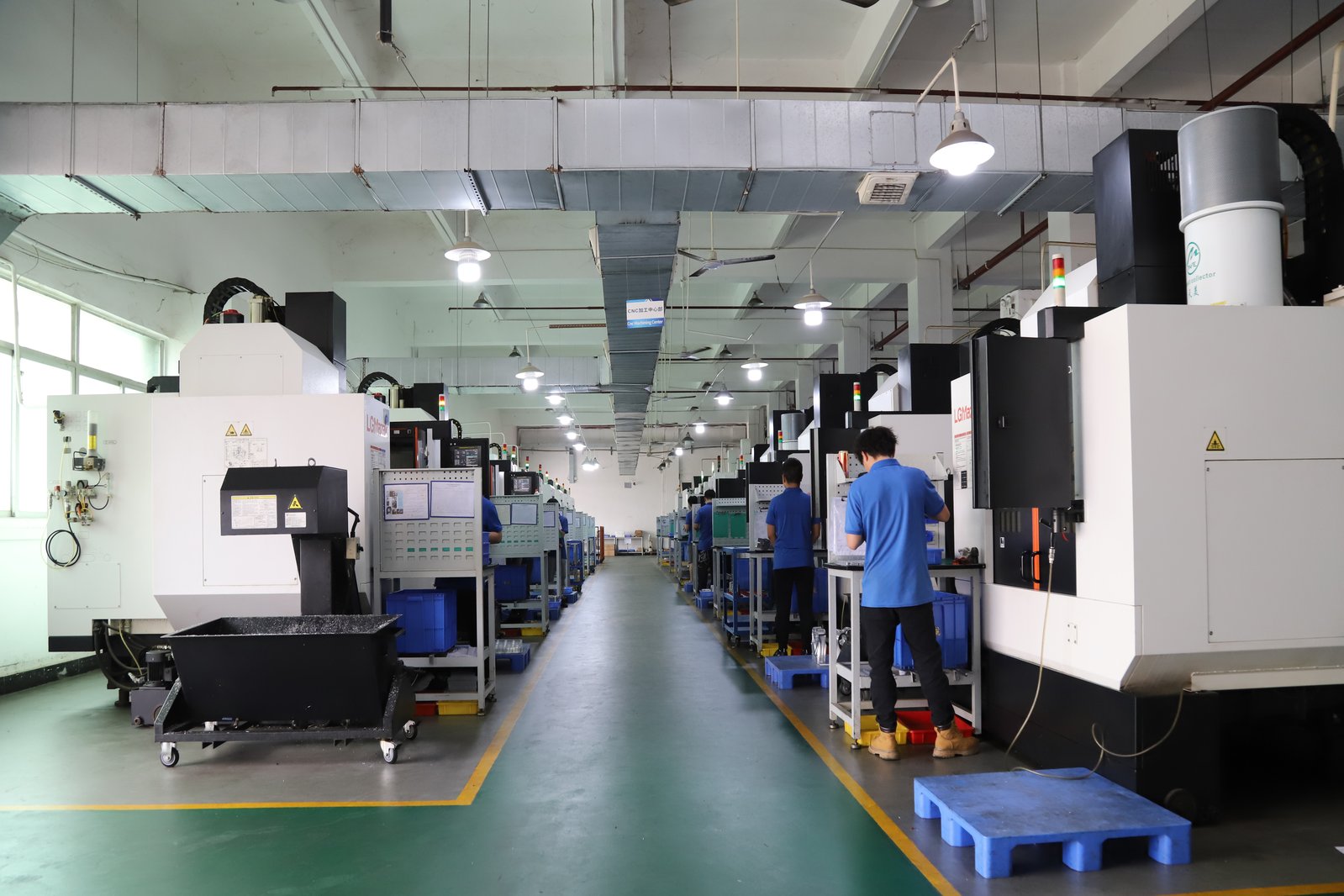
Behind the numbers is a floor you can walk. Dongguan Zhuohang Ltd runs 100+ CNC machines - the Mazak VARIAXIS I-600 five-axis, the INTEGREX I-250H S mill-turn, Brother SPEEDIO, and TSUGAMI, STAR and CITIZEN Swiss lathes - across 6,800 m² in Hengli Town, Dongguan. Every critical feature is checked on a Hexagon CMM under the 10:1 gauge rule, and the certificate numbers for ISO 9001:2015, IATF 16949:2016 and ISO 14001:2015 are published and verifiable. Capability is tracked with Ppk 1.67 or better at the initial study and Cpk 1.33 or better in production, which is the difference between a tolerance that is quoted and a tolerance that is held.
The same floor serves buyers worldwide - Austria, Belgium, the Czech Republic, Denmark, France, Germany, Greece, Hungary, Ireland, Italy, the Netherlands, Spain, Sweden and the United Kingdom in Europe; Brazil, Canada, Mexico and the United States in the Americas; China, Israel, Japan, Singapore and Sri Lanka in Asia; Australia and New Zealand in Oceania; and South Africa in Africa - with shipping from Dongguan. MOQ is 1 piece and lead times run roughly 3 / 7 / 30 days depending on material and documentation. Send the drawing and the quantity to Felipe Iglesias at [email protected] or +86 13126536955, and the quote comes back with the process behind it.
Your next step
A drawing and a quantity are all it takes to turn this page into a real part. Send a STEP or IGES model plus a 2D drawing carrying the tolerances, datums, material grade and finish, and name the quantity and the lead time. That returns an itemised quote - material, setup, cycle time, inspection - instead of a round number. If the drawing is not done, send what exists and the questions holding you back; starting the conversation matters more than waiting for a perfect package.
Reach Felipe Iglesias at [email protected] or +86 13126536955. MOQ is 1 piece, lead times run roughly 3 / 7 / 30 days, and the service area covers Austria, Belgium, the Czech Republic, Denmark, France, Germany, Greece, Hungary, Ireland, Italy, the Netherlands, Spain, Sweden and the United Kingdom in Europe; Brazil, Canada, Mexico and the United States in the Americas; China, Israel, Japan, Singapore and Sri Lanka in Asia; Australia and New Zealand in Oceania; and South Africa in Africa, with worldwide shipping from Dongguan.
What this shop actually runs
Ask for capability evidence and the answer should be specific. The facility behind this guide runs 100+ CNC machines on a 6,800 m2 floor in Dongguan, China, with 100+ staff. The machine list, by category:
- 5-axis machining centres (10+) - Mazak VARIAXIS I-600 (510/910/510 mm travel, 12,000 rpm, 22 kW, 71.6 N·m, 30-tool BT40) and Mazak INTEGREX I-250H S (B-axis 0.0001°, 24 kW, 124 N·m, 38-tool HSK-A63). Typical work: compound-angle parts, single-setup multi-face prismatic work, and aerospace fittings where datum transfer loss is unacceptable.
- 3-axis / 4-axis machining centres (50+) - Brother SPEEDIO S500Z2N / S700Z2N (10,000 rpm, 14/21-tool ATC, 0.7 s tool-to-tool, Z-axis 2.2 G) and Mazak VCE-430A L / VCE-570C L (10,000 rpm, 118 N·m, 24-tool ATC). Typical work: prismatic parts, plates, brackets, housings.
- Swiss-type turning centres (10+) - Citizen Cincom A20-3F7 (Φ20 mm, 10,000 rpm), TSUGAMI B0206-III / B0205-III (Φ20 mm, 0.1 µm), STAR SR-32JII / SR-32J Type N (Φ32 mm, 8,000 rpm). Typical work: long, slender rotational parts at ±0.002 mm.
- CNC turning centres (20+) - HEADMAN T70M/1250 (720 mm swing, 117 mm bore, 3,000 rpm, BMT75 12-station turret). Typical work: shafts, bushings, flanges up to ±0.002 mm.
- Wire EDM (5+) - Sodick AQ535L (550/350/300 mm travel, ±20° taper, 800 kg workpiece). Typical work: hardened tool steel, internal splines, sharp internal corners that milling cannot reach.
- Inspection: Hexagon CMM + 20+ gauges - Hexagon CMM for coordinate measurement, plus vision system, profilometer, hardness tester, coating thickness gauge, XRF for material verification. The 10:1 rule (gauge 10x more accurate than the band) is applied to every feature.
- Machine highlights - VARIAXIS I-600: one-setup multi-face 5-axis + MAZA-CHECK auto-calibration; INTEGREX I-250H S: DONE-IN-ONE mill-turn, B-axis 0.0001° + Ai thermal shield; SPEEDIO S500Z2N / S700Z2N: Z-axis 2.2 G + 0.7 s ATC; Swiss-type: guide-bush switchable + 0.1 µm resolution.
Tolerances held: milling ±0.003 mm, turning ±0.002 mm, grinding and wire EDM ±0.002 mm. Capability: Ppk >= 1.67 initial and Cpk >= 1.33 in production on key characteristics.
Certifications: ISO 9001:2015 (116024/A/0001/UK/En), IATF 16949:2016 (131941/A/0001/SM/En, clause 8.3 design excluded, disclosed openly) and ISO 14001:2015 (116024/B/0001/UK/En), issued to Dongguan Zhuohang Ltd, USCC 91441900MA4UWT6X39, established 2005.
Service area: Austria, Belgium, the Czech Republic, Denmark, France, Germany, Greece, Hungary, Ireland, Italy, the Netherlands, Spain, Sweden and the United Kingdom in Europe; Brazil, Canada, Mexico and the United States in the Americas; China, Israel, Japan, Singapore and Sri Lanka in Asia; Australia and New Zealand in Oceania; and South Africa in Africa — built in China, shipped worldwide.
Contact: Felipe Iglesias, [email protected], +86 13126536955.
Send your drawing for a quote.
Email [email protected] or call +86 13126536955 for a review and quote.
Frequently Asked Questions
1. How do I start and plan a machining project?
In short, Email [email protected] with the drawing, material, tolerance, and expected volume and cadence. We return a price that separates setup from piece cost and names the process recommended at your quantity.
2. How does volume change cost?
In short, At one piece, setup dominates. At volume, cycle time, material yield, and scrap dominate, and Ppk ≥ 1.67 at the initial study on critical characteristics keeps scrap low, which is the largest driver of unit price once setup is paid.
3. How do I scale from prototype to production?
In short, Keep the same supplier and drawing release. We are build-to-print, so the first machined part is the measurement baseline and the production lot is judged against it.
4. What tolerances and materials do you work with, and how is grade proven?
In short, ±0.003 mm CNC milling, ±0.002 mm CNC turning, ±0.002 mm grinding, with Ppk ≥ 1.67 at the initial study on critical characteristics and Cpk ≥ 1.33 in production on general characteristics. Materials span aluminum, stainless, carbon and alloy steel, brass, copper, titanium, magnesium, and engineering plastics.
5. How does process choice change with volume?
In short, At low volume, minimize setup and prove the design (often 3-axis). At volume, minimize total handling (5-axis or mill-turn) and protect tolerance.
6. How do payment, lead time, and shipping work?
Lead time runs 3 / 7 / 30 days for simple / standard / complex work, with MOQ 1 piece. Tooling and setup are stated up front. Because prototype and production share one line, a reorder starts from the first run's baseline instead of a cold start.
7. What should I send to get the volume economics right?
In short, Send the drawing, the material specification, the required tolerance, and your expected volume and cadence, whether that is a one-off, a bridge order, or steady production. We return a price that separates setup from piece cost and names the process we recommend at your quantity, with lead time from the 3 / 7 / 30 day ladder.
What is your minimum order quantity?
Our MOQ is 1 piece. We take prototype and single-part orders as well as production runs, so you can validate a design before committing to volume.
Why do prototypes cost more per piece?
At low volume, the setup cost — programming, fixturing, and first-article inspection — is carried by a single part. At high volume that cost is amortized across thousands of parts.
What dominates cost at high volume?
Once setup is amortized, cost is driven by cycle time, tool life, and yield. Process capability — Ppk ≥ 1.67 at the initial study on key characteristics — keeps scrap near zero and cost predictable.
What tolerances can you hold?
±0.003 mm on CNC milling, ±0.002 mm on CNC turning, and ±0.002 mm for precision grinding. We verify critical dimensions on Hexagon CMMs, with process capability Ppk ≥ 1.67 at the initial study on key characteristics.
Which materials do you machine?
In short, Aluminum, stainless steel, carbon and alloy steel, brass, copper, titanium, and magnesium, plus engineering plastics including ABS, POM, nylon, PTFE, and PEEK. Incoming lots are XRF-checked against the mill certificate so the grade you specify is the grade you receive.
Can I scale from prototype to production with you?
Yes. We run prototype and production on the same a floor of 100-plus machines under one quality system, so the process that made the prototype becomes the production process.
How do I get a quote for the right volume?
Email your STEP, IGES, or 2D drawing to [email protected] with both the order quantity and the annual volume. We return a review and a quote matched to your volume.
8. Which materials and industries do you cover?
In short, We machine aluminum, stainless steel, titanium, brass, copper, and Inconel, plus engineering plastics including PEEK and Delrin. These CNC machined parts go into medical, aerospace, automotive, robotics, electronics, and defense applications, with the inspection, traceability, and documentation each sector requires before it places an order.
What payment methods and terms do you accept?
PayPal, Western Union, and bank or wire transfer. For long-term customers we also accept Net 30, Net 45, and Net 60 terms after an approved credit review.
What happens if a machined part has a manufacturing defect?
We provide free repair or remake for parts with manufacturing defects. All repair and remake costs, including return and shipping, are on us.
How quickly do you respond to inquiries?
We respond to every inquiry within 24 hours. Quotations for standard parts are returned within 48 hours; print reviews and DFM feedback are usually back within one business day.
Standards referenced on this page
- ASTM B211/B211M-19 — Standard Specification for Aluminum-Alloy Rolled or Cold Finished Bar, Rod, and Wire
- ASTM B348/B348M-21 — Standard Specification for Titanium and Titanium Alloy Bars and Billets
- ISO 9001 — Quality management systems — Requirements