
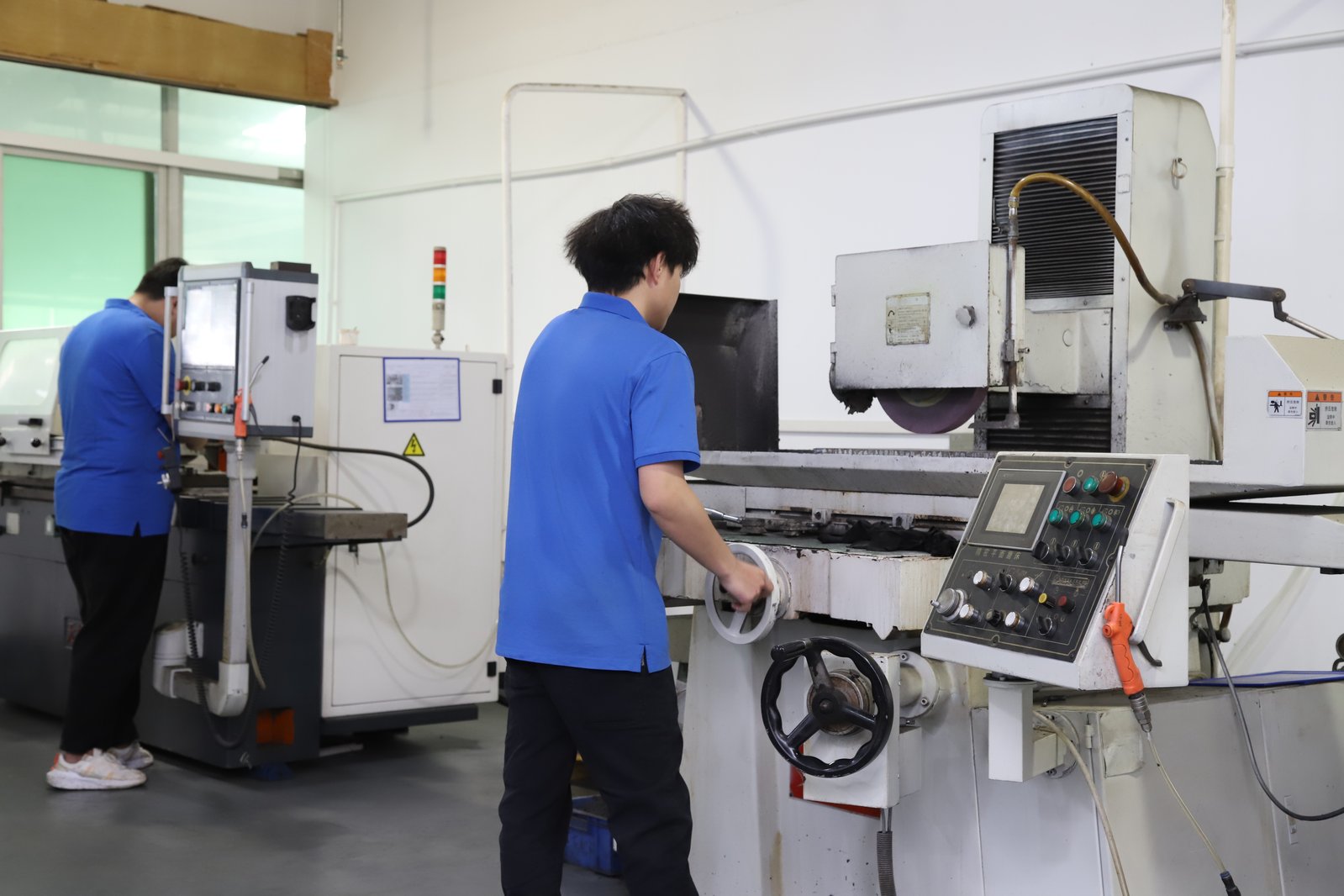
Buying machined components is really two decisions bundled into one: the process decision, which determines how the metal is shaped, and the supplier decision, which determines who controls the hand-offs between shaping and precision finishing. Most buyers treat the two as separate, but on a part with tight callouts they are the same decision, because the company that runs the finishing operations is the one that answers for the tolerance. This guide compares the process routes a buyer can choose — machining from stock, die and investment casting, forging, metal injection molding, sheet fabrication, and additive — and explains when the practical answer is to consolidate them inside one CNC machining company that routes the work internally.
What is really different between the routes a buyer can choose?
Strip each process down to its starting point and the differences become obvious. A machining company begins with certified bar, plate, or billet and removes material until the drawing is satisfied, which means the first article needs no tooling and the tolerance is produced directly by the cutting process. Die casting begins with molten aluminum or zinc injected into a steel die. Investment casting builds a wax pattern, dips it in ceramic, and pours alloy into the shell after the wax is burned out. Forging presses a heated billet inside a die so the grain follows the part's shape. Metal injection molding mixes powder with binder, molds it, and sinters the compact. Sheet fabrication laser-cuts and folds flat stock. Additive printing deposits layers to grow the form.
Only the first of those routes produces its precision as it makes the shape. Every other route delivers a near-net blank whose form tolerance is measured in tenths or hundredths of a millimeter at best, and whose critical bores, seats, threads, and finishes must be cut afterwards. That one fact reframes the entire comparison: when your drawing carries tolerances like ±0.003 mm on a turned or milled feature, the machining is not optional and it is not a cost you can quote away. The question is simply whether your part should be machined completely from standard stock, or whether a forming process should build most of the shape first and leave a defined set of finishing operations for the cutting machines.
Why does a machining company quote tight bands while forming shops quote form tolerances?
The gap is a matter of process physics, not skill. A milling cutter or a turning insert removes metal under controlled geometry, and the resulting surface and size are measured in microns, that is why milling and turning are quoted at ±0.003 mm, with grinding reserved for the features that need ±0.002 mm and capability demonstrated at Ppk ≥ 1.67 initial on the characteristics that matter. A die cavity, a ceramic shell, a forging die, a mold, or a print bed cannot deliver that same control as-formed, because the part's surface is a copy of the tool's surface with shrinkage, draft, scale, and residual stress mixed in.
So when a forming shop says it can hold a tight band, it means it can hold it on the features it will machine after forming, and the buyer should ask who does that machining. A supplier that casts, forges, or molds in-house but subcontracts the finishing passes adds a hand-off at exactly the point where the tolerance risk lives. A CNC machining company that coordinates the forming source and performs the finishing under its own quality system keeps the measurement loop closed. For a buyer, that difference is worth more than the price delta between two quotes, because the parts that matter are the ones whose critical features were cut, measured, and released by one accountable operation.
Which parts should simply be machined from stock and never formed?
Three families of parts belong in stock material almost every time. The first is the low-to-mid volume order, anywhere from a single prototype to a few thousand pieces, where there is no tooling to amortize and the stock route has no competitor on cost or speed. The second is the part whose geometry is mostly solid — a shaft, a pinion blank, a flange, a manifold block, a fitting — because a solid form cut from bar wastes a minority of the material and the rest of the work is pure machining. The third is the part with dense critical features, where several bores, faces, and threads sit in one tight area; concentrating the precision in a solid stock envelope is simpler than chasing it across a cast or forged blank's tolerances.
The practical test for any drawing is to estimate the waste. Take the bounding box of the part, subtract the part volume, and ask whether most of that block would become chips. If the answer is no, machining from stock is probably the cheapest, fastest, and most certifiable route you can choose. If the answer is yes, the part is asking for a near-net start, but notice that the precision features still dictate that a cutting machine finishes the job. The real judgment is not between machining and forming; it is between machining everything and forming the bulk while machining the critical fraction.
When does die casting or investment casting plus finish machining win?
Casting becomes attractive when the drawing describes a shell rather than a solid. A gearbox housing, a pump body, a motor end cap, or an electronic enclosure is mostly empty interior with thin walls and bosses, and cutting that shape from a billet would convert most of the billet into chips and consume hours of spindle time. Die casting handles aluminum and zinc at high rates with good dimensional repeatability across the die life; investment casting takes over where the alloy or the geometry exceeds die casting, trading cycle time for the ability to cast complex contours and harder-to-cast materials.
The buyer's arithmetic for casting is quantity and qualification. The die or the pattern tooling is a six-figure class of decision on complex housings, so the program must be large enough to spread it across enough parts to beat the stock route. The foundry must be qualified for porosity control, because a subsurface void that opens under a machined bore or a pressure-test surface is a defect no finishing pass can cure. And the cast part's certificate is a different document from a mill certificate — alloy verification, heat treatment, and any radiography or pressure testing belong to the casting supplier's story. Compare the full chain at your real volume, with the finishing operations itemized, before the die is cut.
When should a forging be part of the route, and who should finish it?
Forging is the route chosen for material structure, not for shape. The hammer or press works the heated billet so the grain flow follows the component's principal stress paths, which is what gives a forged connecting rod, spindle, or fitting its fatigue margin in cyclic service. A part machined from bar keeps the mill's straight grain running through the part regardless of where the loads concentrate, which is why fatigue-critical specifications routinely call for a forged starting condition. When your drawing or the governing standard says the material must be forged, the route is decided before cost is discussed.
What remains open is who finishes the forging, and that is where the supplier decision bites. A forged blank arrives with scale, draft, and a looser envelope, and the critical journals, bores, and seal faces are machined — often ground — after the forging. If the forge and the machine shop are separate companies, every dimension between the as-forged envelope and the finished datum is a negotiation across two quality systems. A machining company that procures qualified forgings and runs the finish work internally gives the buyer one contract, one inspection report, and one party accountable for the fit. On a fatigue-critical part that accountability is worth more than the modest premium a coordinated chain carries.
Where does metal injection molding belong in a buyer's comparison?
Metal injection molding is the specialist for small, intricate metal parts produced in volumes that justify an injection mold. Powder is blended with a binder, the mix is molded into near-final shape, the binder is leached out, and the part is sintered to full density. The result can include thin walls, small internal details, and complex contours that would tie up a machining center for far too long at volume. On quantities in the tens of thousands, MIM regularly beats machining on cost per part for the right geometry.
Two facts should be on the table before the mold is cut. First, the sintered material is a distinct condition: density, ductility, and strength follow the powder and the sintering profile, not the wrought bar standard of the same nominal grade, so the design authority must accept the sintered microstructure. Second, the as-sintered tolerance is a molding tolerance — generous by machined standards — so the precise holes, threads, and mating faces are finished by cutting after sintering. The quote to compare is MIM plus finishing, not the mold-shot price alone, and a buyer who lines that up against machined-from-stock pricing at the real annual volume gets an honest picture.
When does sheet fabrication or additive printing genuinely fit the route?
Sheet fabrication is the answer for parts that are plate-like by nature. Brackets, covers, enclosures, and chassis panels are laser-cut and folded from sheet at a unit cost that solid machining cannot approach, and the savings grow with quantity. The trade is accuracy: cut and formed geometry holds looser positional and angular bands than machining, so the design has to accept that looseness on the features that do not matter, while the features that do matter — locating holes, mounting faces, tapped patterns — are machined afterwards. The strongest configuration is hybrid: fabricate the flat body, machine the precision features, and let one supplier manage the interface so the bend line and the machined datum agree.
Additive printing earns a place in two narrow situations. It is the only route when the geometry is unreachable — internal conformal channels, lattice structures, or a one-piece manifold that would otherwise be several machined parts joined together. And it is useful for a single prototype that must exist before tooling decisions. Outside those cases, printing loses the comparison on the factors a machined drawing cares about: the surface needs cutting to meet a finish callout, the tolerance depends on build orientation and heat treatment, the material certificate is more involved than a mill certificate, and the per-piece cost stays elevated. EDM, meanwhile, is not a separate route but the machining company's answer for features cutting cannot reach — sharp internal corners, deep narrow slots, and hardened material — finished against the same datum as the milled work.
How do you compare quotes that arrive from different routes and different suppliers?
Put every quote on the same three axes before you choose. Cost per delivered part at your actual annual quantity, including tooling amortization on the forming routes and the finishing operations that each route still requires. Lead time to the first approved part, remembering that a die, a mold, or a forged-die program starts with weeks of tooling before the first piece exists, while a stock program starts when the material is ordered. And risk — the number of hand-offs between quality systems, the maturity of each process source, and the complexity of the certification chain from raw material to finished lot.
Ask each supplier to state its route in the quote: the starting material form and its certificate, the operations that create each critical feature, and the measurement method behind the report. A quote that reads "CNC machined from certified 17-4PH bar" and one that reads "investment cast then machined on critical faces" are different products at similar prices, and the only way to compare them fairly is to line up the whole chain on the same quantity and the same document list. A CNC machining company that runs this analysis daily will tell you honestly where your part should start, and where consolidating the route under one roof saves you the coordination cost that the alternatives quietly add.
Frequently Asked Questions
When is machining from bar the right choice for a component?
Machining from bar fits low-to-moderate volumes, mostly solid geometry that sits inside the stock, short lead times, and drawings with tight callouts. The route needs no tooling and reaches the tightest bands directly; forming processes earn their place when volume is high and the part's shape or properties justify them.
Can cast, forged, molded, or printed parts hold the tolerances of a machined drawing?
Not as-formed. Those processes hold looser form tolerances, and the features the drawing controls tightly are finished by cutting afterwards. A near-net blank almost always needs machining on its critical bores, seats, threads, and finishes before it meets a machined callout.
What does a CNC machining company do better than separate process suppliers?
It routes turning, milling, grinding, and inspection under one quality system, so the datum chain and the measurement loop stay inside one accountable operation. Separate suppliers may each quote lower on their own process, but the buyer carries the hand-offs and the tolerance arguments between them.
How much tooling cost should I expect on forming routes?
Die casting and forging tooling can reach five or six figures for complex parts, and MIM mold tooling is significant as well, so those routes only pay back at higher volumes. Machining from stock carries no tooling at all, which is why it wins on cost at low and mid quantities.
How do tolerances compare across the routes in practical terms?
Milling and turning hold ±0.003 mm, with capability at Ppk ≥ 1.67 at the initial study on key characteristics and Cpk ≥ 1.33 on general characteristics. Capability is reported per characteristic: every report names the feature, its tolerance band, the sample size, the sigma method, and the study window., and precision grinding reaches ±0.002 mm. Die-cast, forged, molded, fabricated, and printed parts hold their own looser bands as-formed and rely on finish machining for the tight features.
Is additive manufacturing ever cheaper than machining?
Printing is cheaper mainly when the geometry cannot be machined at all, or when a single prototype justifies skipping tooling. On conventional solid parts it loses on surface finish, tolerance, certification, and per-part cost, and printed parts that matter are still finish-machined on their critical surfaces.
What should I send a supplier to get an honest route comparison?
Send the final drawing, the material specification with condition, the annual quantity, and the target date, and ask for the route in the quote — the starting material, its certificate, and which features are machined and measured. That makes quotes comparable across routes and exposes hidden finishing stages.
Weighing forming routes against machined-from-stock for a new part?
Send the drawing and the annual volume through the services page, and the process review will name the route it recommends, the certificate behind the material, and the features that will be machined and measured, so competing quotes line up on the same basis.